Search by country
Search by topic
Search by year
National Tokens by country...
Check out all the souvenir coins in the country of your choice.
Below you can find an overview of the general coin specifications that apply to the collection in this country. Scroll down to discover the coins piece by piece, or use the ‘select a coin’ box to jump directly to any specific coin that you are looking for.
Germany
General coin specifications
| Color | Diameter | Thickness | Edge | No. coins | No. variations |
|---|---|---|---|---|---|
|
brass champagne gold silver |
31.00 mm 35.00 mm |
2.25 mm 2.35 mm |
serrated, fine serrated, fine with script smooth |
68 | 143 |
AACHEN
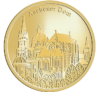
Aachener Dom
The Aachen Cathedral, frequently referred to as the "Imperial Cathedral" of Aachen, is the oldest cathedral in northern Europe. Charlemagne began the construction of the Palatine Chapel in 786. When he died in 814, he was buried in his own cathedral, and his bones are still preserved in a special shrine.
The cathedral obtained its present shape in the course of more than a millennium. The core of the Aachen cathedral is the Palatine Chapel; being surprisingly small in comparison to the later additions, at the time of its construction it was the largest dome north of the Alps. For 600 years, from 936 to 1531, the Aachen cathedral was the church of coronation for 30 kings of the Holy Roman Empire.
In order to bear the enormous flow of pilgrims in the Gothic period a choir hall was built: a two-part Capella vitrea (glass chapel) which was consecrated on the 600th anniversary of Charlemagne's death. Ever since, the magnificent architecture of the "glass house" of Aachen has never stopped being admired. In 1978, it was one of the first 12 sites to make the entry into the UNESCO list of world heritage.
- Location information
- www.aachendom.de
BONN
Altes Rathaus
Bonn's city hall, originally constructed in Roccoco style in 1737, brilliantly dominates the three-cornered market place.
The building was reconstructed after World War II. The building played a significant political role while Bonn was the country's capital, from 1949 to 1999. Many national government institutions were moved from Bonn to Berlin after the after the unification, so the city hall now serves purely ceremonial purposes.
The city hall’s flight of outdoor stairs with its golden grating had been the scene of many historical events. In 1962, Charles de Gaulle, the French President of the State, delivered an address here, and US President John F. Kennedy did so in 1963. The list would become quite long, if all emperors, kings and presidents, as well as all world stars from the sectors of music and sports who visited Bonn were to mention here.
- Location information
- www.bonn.de
BAD HOMBURG
Antoninus Pius
Titus Aurelius Fulvus Boionius Arrius Antoninus, generally known in English as Antoninus Pius was Roman emperor from 138 to 161. He was the fourth of the Five Good Emperors and a member of the Aurelii. Almost certainly, he earned the name "Pius" because he compelled the Senate to deify his adoptive father Hadrian; the Historia Augusta, however, suggests that he may have earned the name by saving senators sentenced to death by Hadrian in his later years.
In marked contrast to his predecessors Trajan and Hadrian, Antoninus was not a military man. His reign was the most peaceful in the entire history of the Principate (the first period of the Roman Empire); while there were several military disturbances throughout the Empire in his time, in Mauretania, Iudaea, and amongst the Brigantes in Britannia, none of them are considered serious.
He was virtually unique among emperors in that he dealt with these crises without leaving Italy once during his reign, but instead dealt with provincial matters of war and peace through their governors or through imperial letters to the cities. This style of government was highly praised by his contemporaries and by later generations.
- Location information
- www.saalburgmuseum.de
GERMANY
Benedictus PP XVI
Pope Benedict XVI (Latin: Benedictus PP. XVI, born Joseph Alois Ratzinger on 16 April 1927) is the 265th and reigning Pope, by virtue of his office of Bishop of Rome, the head of the Roman Catholic Church and, as such, Sovereign of the Vatican City State.
He was elected on 19 April 2005 in a papal conclave, celebrated his Papal Inauguration Mass on 24 April 2005, and took possession of his cathedral, the Basilica of St. John Lateran, on 7 May 2005. Pope Benedict XVI has both German and Vatican citizenship. He succeeded Pope John Paul II.
- Location information
- www.vatican.va
BAD ESSEN
Blütenbert
Blütenbert is the mascot of the national garden show in Bad Essen 2010.
Stefanie Ludwig came up with the idea for the costume of this garden gnome. While Sigrid Schütte gave the gnome a name.
On the 12th of March 2009 the council of Bad Essen decided to apply for the national garden show, and signed the agreement a few weeks later at the 26th of March 2009.
In the beginning of April 2 architect teams were assigned to the project after a design contest for two main areas: ‘Kur- und Solepark’ and ‘Park von Schloss Ippenburg’.
These 2 teams (Carl Landscape Architecture and JKL Landscape Architects) are responsible for the magnificent result.
BERLIN
Brandenburger Tor
The Brandenburg Gate is a triumphal arch, the symbol of Berlin. Located on the Pariser Platz, it is the only remaining one of the series of gates through which one entered Berlin. It constitutes the monumental termination of Unter den Linden, the renowned boulevard of linden trees which led directly to the royal residence. It was commissioned by Friedrich Wilhelm II as a sign of peace and built by Karl Gotthard Langhans from 1788 to 1791.
The Brandenburg Gate consists of twelve Greek Doric columns, six on each side. This allows for five roadways, although originally ordinary citizens were only allowed to use the outer two. Above the gate is the Quadriga, consisting of the goddess of peace, driving a four-horse chariot in triumph. The gate stands 26 meters high, 65,5 meters wide and 11 meters thick
- Location information
- www.berlin.de
LAHNSTEIN
Burg Lahneck
Burg Lahneck is a 13th century castle on the banks of the Rhine, at Lahnstein near Koblenz.
The castle is well-known by the death of Idilia Dubb in June 1851. In her holidays the 17 year old girl mounted the high tower of castle Lahneck, when suddenly the wooden stairs collapsed behind her. Nobody heard her crying and calling on the point of the tower, because it was surrounded with an insurmountable wall 3 meters high. She was only found after years in 1860, her diary hidden in the walls some weeks later. The last sentences in her diary: All I know is that there is no hope for me. My death is certain. ... Father in heaven, have mercy on my soul (drawn down with two hearts).
- Location information
- www.burg-lahneck.de
ANNWEILER
Burg Trifels
Burg Trifels (Trifels Castle) is a medieval castle at an elevation 500m near the small town of Annweiler, in the Palatinate, Germany. It is located on one peak of a three-way split red sandstone rock (the name Trifels means threefold rock), and it is one of the most popular tourist destinations in the area.
First mentioned in a document of 1081, it was a place of safekeeping for the Imperial Regalia of the Holy Roman Empire in the 12th and 13th century. The castle is most famous as the place where the English King Richard I of England (Richard the Lionheart) was imprisoned after his return from the crusades. The castle is characterized by a large well tower outside the ring wall, linked to the castle by a bridge.
- Location information
- www.annweiler.de
BERNKASTEL-KUES
Burgruine Landshut
Bernkastel-Kues is a town over 700 years old, located on the Middle Moselle river in the district of Bernkastel-Wittlich, in Rhineland-Palatinate, Germany. Towering above the city of Bernkastel on a hill is the "Burgruine Landshut" (ruin of the Castle of Landshut), built in 1277.
It became a residence of the bishops of Trier in the 1200s. On January 8, 1692, a devastating fire swept the castle. What remained after the fire was preserved basically as it stands today.
The castle ruin is open to the public, admission free, and gives a beautiful view over the city and the vineyards of the Mosel valley.
- Location information
- www.burgruine-landshut.de
BERLIN
Checkpoint Charlie
Checkpoint Charlie was the name given by the Western Allies to a crossing point between East Berlin and West Berlin during the Cold War, located at the junction of Friedrichstraße with Zimmerstraße and Mauerstraße.
It was designated as the single crossing point for foreigners and members of the Allied forces. The other six checkpoints were for West Germans and/or West Berliners.The name Charlie came for the letter C in the NATO phonetic alphabet. Checkpoint Charlie became a symbol of the Cold War, representing the separation of east and west, and it is frequently featured in spy movies and books.
The border-crossing point was removed in 1990, shortly before formal German reunification. A replica of the original building was rebuilt on the site in 2000, as a symbol of history and a curiosity for tourists.
- Location information
- www.visitberlin.de
COCHEM
Cochemer Sesselbahn
The Cochem chair lift offers you a charming ride that will take you up to the „Pinner Kreuz“. A footpath at the top will take you to one of the most panoramic viewpoints over the town which is dominated by the impressive castle.
The region is famous for its wine industry, and from the top of the hill you get a splendid view over the vineyards on the surrounding hillsides of the Moselle River valley.
- Location information
- www.cochemer-sesselbahn.de
KOBLENZ
Deutsches Eck
The city of Koblenz at the confluence of the Mosel and the Rhine, from which it derives its' name ("Confluentes"» Koblenz).
The point where the two rivers meet is known as "Deutsches Eck" ("German Corner"). The site is dominated by a giant 14 meters high equestrian sculptural monument of Kaiser Wilhelm I, who ruled in Koblenz as the Prussian Military governor from 1850-1857, and is a local hero.
Erected in 1897, the size of the monument is overwhelming. It was partially destroyed during the bombing in April 1944, but finally reconstructed in 1993. There are stairs leading up to the top of the monument, where you have a great view of the confluence of the 2 rivers.
The flags that surround the tip of land represent the 16 different German states known as Laender, and at the outer tip you wil find the European Community flag as well as the German and American flags, a symbol of peace between the countries today.
- Location information
- www.koblenz.de
ROSENHEIM EXHIBITION CENTER
Dinosaurs - Giants of Argentina
They are creatures of superlatives: the longest one measured nearly 40 meters, the oldest one lived 235 million years ago.
The Lokschuppen exhibition center in Rosenheim presents world-wide for the first time spectacular finds in its new exhibition "Dinosaurs - Giants of Argentina" and takes the visitors on a time travel into geologic history. Suitably in the year of the 200th birthday of Charles Darwin, the creator of the theory of evolution.
Singular finds from the scientific collections of 7 Argentinian museums permit an almost complete representation of the history of the dinosaurs, with nearly complete fossils and lifelike reconstructions of what these impressive creatures and their habitat must have looked like millions of years ago.
- Location information
- www.dinosaurier-ausstellung.de
HANN. MÜNDEN
Dokter Johann Andreas Eisenbart
Johann Andreas Eisenbarth (March 27, 1663 in Oberviechtach – November 11, 1727 in Hann. Münden) was a German physician
Eisenbarth was baptized as a catholic on the 27th of March in Oberviechtach. His father, Mathias Eisenbarth was an oculist. Being born as the son of an oculist, Eisenbarth soon followed his father in his footsteps and became an oculist himself. He went to school in Bamberg and was a student of the oculist Alexander Biller.
Eisenbarth was a travelling doctor, after his final exams in 1685 he started his journey. He travelled from country to country and became famous due to his 'miracles'.
In 1689 Eisenbarth became a citizen of Erfurt and not much later he gave himself the name of: 'citydoctor of Erfurt.
After some years, in 1703 more specifically, Eisenbarth travelled to Magdeburg and became a citizen there. In Magdeburg Eisenbarth bouth his house which is named: 'Zum Gülden Apfel'.
ERFURT
Dom und Severikirche
Erfurt’s landmark is the unique ensemble created by the combined effect of the Mariendom (Cathedral of The Blessed Virgin Mary) together with the Severikirche (St. Severus Church). These two magnificent examples of German Gothic architecture at its best majestically dominate the cityscape. The "Gloriosa" (1497), the "Queen of Bells", has been praised for centuries throughout Europe for its magnificent resonance.
Inside the cathedral there is an elaborate Gothic chancel with a series of 13 coloured stained-glass windows which are almost 13 meters high and are among the greatest works of medieval stained-glass art. The cathedral contains many noteworthy art treasures that have been created throughout the various centuries. A wide and impressive open-air stairway leads up from the market square to the cathedral itself and to the Church of St. Severus (1278 - 1400), which contains the sarcophagus of St. Severus (1363).
- Location information
- www.dom-erfurt.de
REINHARDSWALD
Dornröschenschloss Sababurg
Sababurg fairytale castle of Brothers Grimm's Sleeping Beauty was founded in 1334 by the Archbishop of Mainz under the name of Zappenborgk to protect the pilgrims on their way to the nearby holy site of Gottsbüren. There, in the heart of Reinhardswald Forest, the Landgraves of Hesse erected a splendid hunting seat on the foundation walls of the original structure in 1490.
In the early 19th century, the castle was abandoned as a residence. The building complex rapidly fell into disrepair, converting to a wild romantic state. Already in the 19th century after the publication of the Brothers Grimm's Fairy Tales, people imagined this to be the place where the Sleeping Beauty tale must have happened:
The ‘sleeping' castle, entwined with ivy and deeply hidden in the Reinhardswald Forest, surrounded by a high wall that wassaid to have been the impenetrable thorn hedge...
Around 100 years later, the long sleep was over and the castle was kissed awake and restored for visitors.
- Location information
- http://www.sababurg.de/
KÖNIGSWINTER
Drachenfelsbahn
The Drachenfels (“Dragon's Rock”) is a mountain (321 m) in the Siebengebirge mountain range near Bonn. One German legend recounts, that Siegfried – the hero of the Nibelungenlied – killed a dragon (German: Drachen) living in a cave in the mountain. After taking a bath in its blood, he became invulnerable.
The Drachenfels Railway or Drachenfelsbahn runs from Königswinter to the summit of the Drachenfels mountain at an altitude of 289 m.The rack railway is 1.5 km long and manages an elevation gain of 220 m at a maximum gradient of 22%.
The line opened with steam traction, on July 13, 1883 and was converted to electric traction in 1953. With a fresh outfit and a modernized station, the “Bergbahnen im Siebengebirge AG” have been given a new look, and one of the four remaining German cog railways will continue to be in service in the Rhineland.
- Location information
- www.drachenfelsbahn-koenigswinter.de
VAALS
Drielandenpunt
On Mount Vaals, southwest of Aachen, the borders of Germany, Belgium and the Netherlands meet.At 323m above sealevel, the highest elevation in the Netherlands is only a few meters from the three border point. On the Belgian side, there is a tower with a panoramic view of the three countries. Most tourist attractions are in the Netherlands: A Labyrinth, a playground, clay pigeon shooting, souvenir shops and restaurants. The German side is a forest.
The Three Country Point is accessible by car from Gemmenich in Belgium and Vaals in the Netherlands. The borders are marked on the ground surrounding the boundary marker. The fourth line within the Belgian segment hints at the area "Neutral-Moresnet", which was established in 1816 due to a dispute over a zinc mine, but became part of Belgium in 1919.
- Location information
- www.drielandenpunt.be www.drielandenpunt.nl
RÜDESHEIM
Drosselgasse
Rüdesheim is situated in the midst of the German wine producing region. Riesling grapes are the main type grown in this area, producing mainly high-quality white wines. One can sample the local wines, including the Rüdesheimer Riesling, in the many wine houses in Rüdesheim.
The Drosselgasse is the epicentre of Rudesheim's old town, full of beautifully decorated restaurants. Live band entertainment brass instrument and dance music play all day and all night during the summer in the many wine houses and open-air garden taverns along the 144 meter long narrow cobblestone pedestrian street. Built in the 15th Century, the Drosselgasse was for boat owners to move items from the river to homes in the town.
The Drosselgasse is Rüdesheim's most famous attraction and is almost always crowded with tourists.
- Location information
- www.drosselgasse.de
KÖLN
Eau de Cologne
It is told that in 1792 a Carthusian monk presented the young Muelhens couple with a valuable wedding gift. It was a secret formula for the production of an "aqua mirabilis", later called Eau de Cologne. Wilhelm Muelhens soon realised the value of this formula and founded a company for the production of Eau de Cologne at Glockengasse, where the original building can still be found today.
Number 4711 was the house number that was given to the factory at Glockengasse during French occupation of the Rhineland in the early 19th century. The picture of the French military officer, painting the house number 4711 on the facade while sitting on his horse, is a product of advertising. A piece of tapestry which had been ordered and made in the 1920s, served as a model. The scenic version of it spread widely in the 1950s and the 1960s.
- Location information
- www.4711.com
BERLIN
Fernsehturm
The Fernsehturm is a television tower in the city centre of Berlin. This well-known landmark, close to Alexanderplatz, was constructed between 1965 and 1969 by the former German Democratic Republic. The GDR administration intended it as a symbol of Berlin, which it remains today, as it is easily visible throughout the central and some suburban districts of Berlin.
The height of the tower rose to 368 m after the installation of a new antenna in the 1990s. The Fernsehturm is the fourth tallest freestanding structure in Europe. There is a visitor platform and a rotating restaurant in the middle of the sphere, at a height of about 204 m above the ground where visibility can reach 42 km on a clear day.
When the sun shines on the Fernsehturm's tiled stainless steel dome, the reflection usually appears in the form of a cross. This effect was neither predicted nor desired by the planners. As a jibe against the atheist foundations of the Communist government, and the ongoing suppression of church institutions in East Germany, Berliners immediately named the luminous cross Rache des Papstes, or "Pope's Revenge".
- Location information
- www.tv-turm.de
KOBLENZ
Festung Ehrenbreitstein
Festung Ehrenbreitstein is a fortress on the same-named mountain on the right side of the Rhine opposite to the town of Koblenz in the Rhineland-Palatinate.
Ehrenbreitstein is one of the largest and most impressive of the 19th century fortresses. Although there is nothing left of the original medieval castle with the earliest pentagonal keep on the Rhine, the ground and during the centuries was added to and extended, growing slowly into a massive fortress complex. Time and again, when danger threatened, the fortress served as a sanctuary for troubled rulers or for the holy relics of Treves, including the Holy Coat.
The fortress today is home to the administration offices of the body that looks after the castles and antiquities of the Rhineland Palatinate, as well as the regional museum of Coblence with its collection on the history of technology, a youth hostel, restaurants, and local authority offices.
- Location information
- www.festungehrenbreitstein.de
FREUDENSTADT
Freudenstadt
Freudenstadt, situated on a high plateau at the edge of the Black Forest, was founded in 1599 and built in the late Renaissance style by Heinrich Schickhardt. Schickhardt, also referred to as "Swabia's Leonardo da Vinci" was the architectural planner employed by Duke Friedrich I, whose intention was to build a palace in the center of Freudenstadt.
However, the sudden death of the Duke caused these plans to be abandoned. This is why Freudenstadt can ever since boast Germany's largest market square, entirely surrounded by arcaded houses.
The Gothic/Renaissance Evangelical Lutheran Church, with its green tower roofs dates back to the beginning of the 17th century and is considered Freudenstadt's most significant building.
- Location information
- www.freudenstadt.de
MAYEN
Genovevaburg
The 700-year-old Genoveva castle sits dominantly above the city centre of Mayen, the largest city in the Eifel.
The castle has known a very turbulent history. It was as good as completely burned down during the occupation of the French troops in 1689, after which it was reconstructed in baroque style around 1700. After being hit by bombs during the airstrikeS of 12 December 1944 and 2 January 1945, the castle was again reconstructed. Renovation persisted until 1984.
Since 1989 the castle houses the popular Eifel museum. The Eifel region has since long been a centre for mining and processing of volcanic rock, and a slate mine lies right beneath the Genoveva castle. The history of slate mining in the Eifel region, from its very beginning around 2000 years ago through to the present day, is clearly illustrated in the underground tunnels of the mine. The system of tunnels was constructed by miners during the Second World War to provide an air raid shelter for the local people.
- Location information
- www.mayen.de
NEUSTADT AN DER WEINSTRAßE
Hambacher Schloss
Hambach Castle is located on the mountain Schlossberg (Castle mountain) in Neustadt an der Weinstraße (Rhineland-Palatinate). There is little known about its early history; the big estate was said to be one of the most important facilities of the Bishopric of Speyer in the late Middle Ages.
Hambach Castle is considered to be the symbol of the German democracy movement because of the Hambacher Fest which occurred here in 1832.
This was a German national democratic meeting where 30,000 participants from all ranks of society stood up for liberty, civil rights and national unity. The event had no immediate results, but is nevertheless considered to be a milestone in German history.
Today the national memorial is a museum and convention centre in which events of the federal state Rhineland-Palatinate, the District Bad Dürkheim and the city Neustadt an der Weinstraße take place all year round.
- Location information
- www.hambacher-schloss.de
OBERSTDORF
Heini-Klopfer-Skiflugschanze
Oberstdorf is the leading wintersports resort located in the Allgäu region of the Bavarian Alps. This is where the World Nordic Championships were held in 1987. The summits of the Nebelhorn and Fellhorn provide dramatic panoramic views of the alps.
Visitors can ride a unique diagonal elevator to the top of the Heini-Klopfer-Skiflugschanze.
Ski jump fact sheet:
- Foundation: 500 m² of concrete
- Anchoring: 40 Steel anchors of 14m deep
- Length: 144m
- Height: 72m
- Inclination: 39°
- Overhang: 57m
- Jump off speed: approximately 106 km/h
- Jump length: approximately 260m
- Difference in height: approximately 132m
- Location information
- www.skifliegen-oberstdorf.com
HOCKENHEIM
Hockenheimring
The Hockenheimring is an automobile racing track situated near the town of Hockenheim in Baden-Württemberg, Germany. Amongst other motor racing events, it holds the annual Formula One German Grand Prix.
In July 2006, Bernie Ecclestone announced that from 2007 onwards, there would be only one Grand Prix per year in Germany. Since 1995, there had been two Grands Prix every year in Germany; the German Grand Prix at Hockenheim, plus either the European Grand Prix or the Luxembourg Grand Prix at the Nürburgring. From 2007 onwards, the Nürburgring and Hockenheimring will alternately host the German Grand Prix,
The new Hockenheim Grand Prix circuit, built in 2002, has a length of 4,574 m and a width of minimum 15m. The track combines 17 bends and 6 straights. Situated in the Rhine valley, the circuit is almost completely flat, with very little change in elevation. The current lap record is 1:13.780 ( Kimi Räikkönen, McLaren, 2004).
The Hockenheim complex also features a quarter mile track for drag racing. It hosts one of the largest drag racing events in Europe known as the NitroOlympx.
- Location information
- www.hockenheimring.com
HOCKENHEIM
Hockenheimring
The Hockenheimring is an automobile racing track situated near the town of Hockenheim in Baden-Württemberg, Germany. Amongst other motor racing events, it holds the annual Formula One German Grand Prix.
In July 2006, Bernie Ecclestone announced that from 2007 onwards, there would be only one Grand Prix per year in Germany. Since 1995, there had been two Grands Prix every year in Germany; the German Grand Prix at Hockenheim, plus either the European Grand Prix or the Luxembourg Grand Prix at the Nürburgring. From 2007 onwards, the Nürburgring and Hockenheimring will alternately host the German Grand Prix,
The new Hockenheim Grand Prix circuit, built in 2002, has a length of 4,574 m and a width of minimum 15m. The track combines 17 bends and 6 straights. Situated in the Rhine valley, the circuit is almost completely flat, with very little change in elevation. The current lap record is 1:13.780 ( Kimi Räikkönen, McLaren, 2004).
The Hockenheim complex also features a quarter mile track for drag racing. It hosts one of the largest drag racing events in Europe known as the NitroOlympx.
- Location information
- www.hockenheimring.com
KÖLN
Hohe Domkirche St. Peter und Maria
The Cologne Cathedral is one of the best-known architectural monuments in Germany and is Cologne's most famous landmark. Construction of the gothic church began in 1248 and took more than 600 years to complete - it was finally finished in 1880. At its completion, the Cologne cathedral was the world's tallest building, and it still features the largest church facade in the world.
The two towers are 157m tall, the cathedral is 144m long and 86m wide. The cathedral is dedicated to Saints Peter and Mary.
It is possible to climb a spiral staircase to a viewing platform about 98 metres above the ground. This climb covers over 500 steps.
In 1996, the cathedral was added to the UNESCO World Heritage List of culturally important sites. In 2005 Pope Benedict XVI visited the cathedral as part of his apostolic visit to Germany as part of World Youth Day 2005 festivities.
- Location information
- www.koelner-dom.de
FÜSSEN
Hohes Schloss
The town of Füssen is charmingly located on the edge of the Bavarian Alps, framed in by imposing high mountain peaks and an idyllic lake district.
The Hohes Schloss (High Castle) is Füssen’s landmark, towering over a maze of narrow lanes. This is the former summer residence of the prince bishops of Augsburg and one of Swabia’s largest and best preserved late gothic castle complexes.
The living quarters today house a branch gallery of the Bavarian State Collections of Paintings. The facades in the castle courtyard are adorned with illusionist paintings that delude the viewer into seeing oriels, window frames and molded corners.
- Location information
- www.tourismus-fuessen.de
BERCHTESGADEN
Kehlsteinhaus (Eagle's Nest)
The Kehlsteinhaus, also known as the Eagle's Nest, was an extension of the Obersalzberg complex built by the Nazis in the German Alps near Berchtesgaden.
It is situated on a ridge at the top of the Kehlstein mountain (1834 m), reached by a spectacular 6.5 km road that cost 30 million Reichsmark to build. The last 124 metres up to the Kehlsteinhaus are reached by an elevator bored straight down through the mountain and linked through a long granite tunnel below.
The Kehlsteinhaus was an official 50th birthday present for Adolf Hitler. Nicknamed Eagle's Nest by a French diplomat, it was meant to be a retreat for Hitler and a place for him to entertain visiting dignitaries.It has been suggested he only visited the Kehlsteinhaus around 10 times, and most times for no more than 30 minutes. Perhaps because of this lack of close association with Hitler, the property was saved from demolition at the end of the war.
Today the building is owned by a charitable trust, and serves as a restaurant. It is a popular tourist attraction, particularly for British,Canadians and Americans attracted by the historical significance of the "Eagle's Nest".
- Location information
- www.kehlsteinhaus.com
BERCHTESGADEN
Königssee
The Königssee is a lake located in the extreme southeast of the German State of Bavaria, near the German-Austrian Border, and is the deepest lake in Germany.
The lake was formed by glaciers during the last ice age. It is 7.7 kilometers long and about 1.7 kilometers across at its widest point. Except at its outlet, the Königsseer Ache at the village of Königssee, the lake is surrounded by steeply rising flanks of alpine mountains (2.000 m), including the famous Watzmann.
The lake is noted for its clear water and is advertised as the cleanest lake in Germany. For this reason, only electric driven boats, rowboats and pedal boats have been permitted on the lake since 1909. The lake and surrounding parklands are very popular with tourists and hikers.
St. Bartholomä, a famous pilgrimage church, is located about halfway down the western lakeshore.
- Location information
- www.berchtesgaden.de
KONZ
Konzer Doktor
The 'Konzer Doktor' statue by sculptor Willi Hahn represents the characters from Konz' folk tales, such as the 'Fotschelgeist' or the 'Breesterfrauchen'. The main character in this sandstone sculpture, however, is the historical figure of the local teacher Georg Canaris (1740-1819), whose teaching methods apparently gave the students in Konz such a big lead on those of other villages, so that he earned the nicknames 'Konzer Doktor'.- Location information
- www.konz.de
BAD FRANKENHAUSEN
Kyffhäuser
The Kyffhäuser is a mountain located at the border of Thuringia. The mountain has significance in German traditional myth as the resting place of Holy Roman Emperor Friedrich Barbarossa, a charismatic leader who died in 1190 while on a crusade.
Located in the middle of the Kyffhäuser Mountains, there are ruins still to be seen for visitors of the 11th century residence Kyffhausen, one of the largest and strongest medieval fortress constructions in Germany. Especially impressive however is the imposing Kyffhäuser Memorial (1890-1896) with its equestrian statue of Emperor Wilhelm the First an the statue of Barbarossa hewed out of stone.
According to legend, Barbarossa is not in fact dead, but sleeps in a hidden chamber underneath the Kyffhäuser mountain, sitting at a stone table. As in the similar legend of King Arthur, Barbarossa supposedly awaits his country's hour of greatest need, when he will emerge once again from under the mountain.
- Location information
- www.kyffhaeuser-tourismus.de
ST. GOAR
Loreley
The Loreley is a rock in the Rhine near St. Goarshausen, which soars some 120 meters above the water line. It marks the narrowest part of the river between Switzerland and the North Sea.
The name comes from the old German words "lureln" (Rhine dialect for "murmuring") and "ley" (rock). The translation of the name would therefore be: "murmur rock" or "murmuring rock". The heavy currents, and a small waterfall in the area (still visible in the early 19th century) created a murmuring sound, and this combined with the special echo the rock produces which acted as a sort of amplifier, then gave name to the rock itself.
The rock is associated with several legendary tales originating in German folklore. It appears in many forms, but is best known through a poem by Heinrich Heine that begins "Ich weiss nicht was soll es bedeuten" ("I don't know what to make of it"). In the most common form of the story, the Loreley is a maiden who threw herself into the Rhine in despair over a faithless lover, and became a nixe whose voice lured fishermen to destruction.
- Location information
- www.st-goar.de
BONN
Ludwig van Beethoven
Ludwig van Beethoven (1770–1827) was a German composer and pianist, acknowledged as one of the giants of classical music.
He was a crucial figure in the transitional period between the Classical and Romantic eras in Western classical music, and remains one of the most respected and influential composers of all time.
Born in Bonn, he moved to Vienna in his early twenties and settled there, studying with Joseph Haydn and quickly gaining a reputation as a virtuoso pianist.
Beethoven's hearing gradually deteriorated beginning in his twenties, yet he continued to compose, and to conduct and perform, even after he was completely deaf.
- Location information
- www.bonn.de
MANDERSCHEID
Manderscheider Burgen
Manderscheid, a charmingly situated village in the Lieser valley, is known for its two castles: Oberburg (the upper castle) and Niederburg (the lower castle).
The Manderscheid family was the most powerful family in the Eifel region of Germany for a considerable period of time in the 15th century, and until today the imposing ruins remind the visitor of the glory of bygone times when the counts of Manderscheid had their residence here.
Niederburg Castle was probably built in the 12th century, shortly after Oberburg Castle had been built. By 1688 at the latest, Niederburg Castle and Oberburg Castle were destroyed. After being in the possession of France and then of Prussia both castles became administered by the Castles Administration of Rhineland-Palatinate. Niederburg Castle was restored in the late 70's and Oberburg Castle in the early 90's.
Niederburg Castle consists of more remnants than Oberburg Castle. It can be seen from far away because of its three-storey keep of the 12th century, having a trapezium shape.
- Location information
- www.niederburg-manderscheid.de
COCHEM
Marktplatz
Cochem is probably the finest looking castle and scene directly on the banks of the Mosel river. The castle enjoys a commanding view over the Mosel and the town of Cochem. However even with the commanding view and the steep access to the castle, history has not been kind to the original. It was seized by the German emperor in 1151 and in 1294 was mortgaged to the archbishop of Trier.
The square tower visible at the center of the castle is the keep that served as a last gasp refuge for its residents when the battle created a serious threat of breach by the enemy. This did in fact happen in 1689 when King Louis XIV of France had the castle totally destroyed. It remained a ruin for about 200 years.
It was completely rebuilt by a Berlin merchant, Louise Ravene, according to the original plans. So, while the structure may not be the original, the plans are true to the original. It was sold by force to the German government in 1942 and since 1978 has been the property of the town of Cochem.
NÜRBURG
Neue Nürburgring 2009 #1
The Nürburgring is currently being expanded into a year-round leisure and business centre in order to provide visitors with better service, more offers and even more possibilities when it comes to motor sport. When you arrive you will be welcomed into the new welcome center.
From there you move on to the ring boulevard - an adventure world of brands from leading car manufacturers and accessories specialists. In addition, the new ringwerk has created an indoor theme park - a science centre, a museum and an adventure world rolled into one - all about the Nürburgring and motor sport in general.
- Location information
- http://www.nuerburgring.de/english/company/nuerburgring-2009.html
NÜRBURG
Neue Nürburgring 2009 #2
The Nürburgring is currently being expanded into a year-round leisure and business centre in order to provide visitors with better service, more offers and even more possibilities when it comes to motor sport. When you arrive you will be welcomed into the new welcome center.
From there you move on to the ring boulevard - an adventure world of brands from leading car manufacturers and accessories specialists. In addition, the new ringwerk has created an indoor theme park - a science centre, a museum and an adventure world rolled into one - all about the Nürburgring and motor sport in general.
- Location information
- http://www.nuerburgring.de/english/company/nuerburgring-2009.html
MANDERSCHEID
Niederburg
Manderscheid, a charmingly situated village in the Lieser valley, is known for its two castles: Oberburg (the upper castle) and Niederburg (the lower castle).
The Manderscheid family was the most powerful family in the Eifel region of Germany for a considerable period of time in the 15th century, and until today the imposing ruins remind the visitor of the glory of bygone times when the counts of Manderscheid had their residence here.
Niederburg Castle was probably built in the 12th century, shortly after Oberburg Castle had been built. By 1688 at the latest, Niederburg Castle and Oberburg Castle were destroyed. After being in the possession of France and then of Prussia both castles became administered by the Castles Administration of Rhineland-Palatinate. Niederburg Castle was restored in the late 70's and Oberburg Castle in the early 90's.
Niederburg Castle consists of more remnants than Oberburg Castle. It can be seen from far away because of its three-storey keep of the 12th century, having a trapezium shape.
- Location information
- www.niederburg-manderscheid.de
RÜDESHEIM
Niederwalddenkmal
The Niederwald Monument was built in the years from 1877 to 1883. The 38 m high monument was meant to commemorate the Franco-German War of 1870-1871 and the re-establishment of the German Empire.
It is located above the city of Rüdesheim in the federal state of Hessen and can be regarded as the landmark of the region. The 32 meters tall statue can be seen from quite a distance.
Each year thousands of tourists as well as locals pilgrimage to the Germania in order to commemorate the victims of the Thirty Years’ War.
The central figure of the monument is the 10.5 meters high and 32 tons heavy “Germania”. In her right hand she is proudly holding the recovered crown of the emperor, with her left she leans self-confidentially on the sword of the empire.
- Location information
- www.niederwalddenkmal.de
BORKUM
Nordseebad Borkum
Borkum is an island in the Leer District in Lower Saxony, northwestern Germany. It has an area of about 30.6 km² and a population of about 5.587. Borkum is bordered to the west by the Westerems strait (which forms the border with the Netherlands), to the east by the Osterems strait, to the north by the North Sea, and to the south by the Wadden Sea. It is the westernmost of the East Frisian Islands in the North Sea, due north of the Dutch province of Groningen.
Borkum formed from two islands which were still parted by a flow of shallow water in 1863. The seam between the former eastern and western parts is called Tüskendör ("through in between").
- Location information
- www.borkuminfo.de
NÜRBURG
Nürburgring
The Nürburgring known as simply "the Ring" by motorsports enthusiasts, is a famous race track in Germany.
It features several track configurations. Only the shorter, modern 1980s version called "GP-Strecke" is currently used by major and international racing events. Michael Schumacher set the lap record on this 5.148 kilometres long track at 1'29.468 (Ferrari, 2004).
However, the older, much longer version of the Ring called the Nordschleife ("Northern Loop"), built in the 1920s around the village and medieval castle of Nürburg in the Eifel mountains, is still in use; nicknamed "The Green Hell" (Grüne Hölle) by Jackie Stewart, it is widely considered the toughest and most demanding purpose-built race track in the world.
Because of its demanding layout, the Nordschleife is used by many auto manufacturers as a proving ground for car prototypes. Some of the most notable corporate "Ring Rats" are BMW, Porsche, Mercedes-Benz, Audi, Nissan, Lexus and General Motors.
Since 1985 the Nürburgring has also hosted the "Rock am Ring", Germany's biggest Rock Festival, attracting close to 100,000 rock fans each year.
- Location information
- www.nuerburgring.de
KONZ
Rathaus Konz
The city of Konz couches on the confluence of Saar and Mosel and is the biggest wine producing community in the Mosel Saar Ruwer agricultural area. Konz is an ideal starting point for trips in the at trips at the place where Germany, France and Luxemburg meet.
The town hall on the market place town dates from the 1950's and remembers the baroque atmosphere of the Electorate in its details.
- Location information
- www.konz.de
COCHEM
Reichsburg
Cochem is probably the finest looking castle and scene directly on the banks of the Mosel river. The castle enjoys a commanding view over the Mosel and the town of Cochem. However even with the commanding view and the steep access to the castle, history has not been kind to the original. It was seized by the German emperor in 1151 and in 1294 was mortgaged to the archbishop of Trier.
The square tower visible at the center of the castle is the keep that served as a last gasp refuge for its residents when the battle created a serious threat of breach by the enemy. This did in fact happen in 1689 when King Louis XIV of France had the castle totally destroyed. It remained a ruin for about 200 years.
It was completely rebuilt by a Berlin merchant, Louise Ravene, according to the original plans. So, while the structure may not be the original, the plans are true to the original. It was sold by force to the German government in 1942 and since 1978 has been the property of the town of Cochem.
- Location information
- www.burg-cochem.de
BAD DÜRKHEIM
Riesenfass
Bad Dürkheim is in the record books for the "Dürkheimer Fass" - the largest wine barrel in the world which could hold up to 1.700.000 litres. It was built in 1934 by Fritz Keller, a winemaker and cooper.
Two hundred 40 metres tall pines - about 200 m³ of wood - were used for building the barrel, which has a diameter of 13,5 m.
The barrel has never actually been filled with wine, inside it there is a rustic-style wine bar and restaurant. The interior is just as barrel-like as the outside, with skilfully carved oak barrel ends hanging on the walls illustrating the art of wine making. In summer you can sit outside in the wine garden in the shade of the giant cask.
- Location information
- www.bad-duerkheim.de
BAD HOMBURG
Saalburg
The Saalburg is a beautifully reconstructed Roman fort located on the Taunus ridge northwest of Bad Homburg. It is a Cohort Fort belonging to the Limes Germanicus (Latin for Germanic frontier), a remarkable line of frontier forts that divided the Roman Empire and the unsubdued Germanic tribes from the years 83 to 260.
At its height, the limes stretched from the North Sea outlet of the Rhine to near Regensburg on the Danube. The total length was 568 km and included at least 60 castles and 900 watchtowers.
In 2005, the remnants of the Upper Germanic & Rhaetian Limes, including Saalburg, were inscribed on the List of UNESCO World Heritage Sites as Frontiers of the Roman Empire.
- Location information
- www.saalburgmuseum.de
SAARBURG
Saarburg castle
The lively history of the city of Saarburg and its castle began in 964 A.D. with the purchase of mount "Churbelun" by Count Siegfried von Luxemburg.
Of all the german castles built upon hills, the Saarburg is one of the oldest and loveliest. Its circular fortification, 137 meters long and up to 50 meters wide, was surrounded by 8-meter high walls. Because of its excellent topographical location - on a hilltop, surrounded by a river and ponds - not many invaders were successful in conquoring the Saarburg. The fortress offers a wonderful view of the city and of the Saar River Valley.
- Location information
- http://p51470.typo3server.info/
SAARBURG
Saarburg waterfall
The city of Saarburg, known for its Medieval character, its bell foundry and its wine, is situated in the hilly landscape of the Saar River Valley. Its natural and historical attractions impress many guests year after year.
The waterfall on the Leukbach is the main attraction of the town today. The Leukbach flows through the middle of the city and plunges over a 20-meter cliff before it empties into the Saar River.
- Location information
- http://p51470.typo3server.info/
SAARLAND
Saarschleife
Saarland is one of the 16 states of Germany, named after the Saar River which runs through the state from the south to the northwest.
Forest-lovers don't have far to go in the Saarland - one third of the land area of the Saarland is covered by forest, one of highest percentages in Germany.
Saarschleife is a quite remarkable place along the rivers course. Here, the Saar gradually carved its way through the mountains throughout the ages, creating a loop of 180 degrees. The forest trails on the surrounding hills provide a fantastic, breathtaking panorama of the "Saarschleife" horseshoe bend.
- Location information
- www.tourist-info.mettlach.de
BERCHTESGADEN
Schloss Berchtesgaden
The town of Berchtesgaden is located in the south-east corner of Germany, just across the Austrian border from Salzburg.
The Augustine Abbey of Canons founded in 1102 eventually became an independent church state within the German Empire and became a prince-provostry in 1559. Until it was secularized in 1803 the monastery remained the residence of the ruling lords of Berchtesgaden. The castle became the summer residence of the Bavarian royal family in 1810.
The castle complex is the result of centuries of construction, alterations and additions that continued until the end of the 1700s. Though it is still privately owned by the Bavarian royal family, the main rooms are open to the public on regularly-scheduled guided tours. The upper rose garden with Renaissance fountains allows for an unbelievable view of the mountains and the “Watzmann”.
- Location information
- www.haus-bayern.com
KÖNIGSWINTER
Schloss Drachenburg
The Castle Drachenburg is a romantic castle surrounded by the wonderful nature of the Siebengebirge, which is definitely worth seeing.
Built between 1882 and 1884 by Stephan Sarter, a wealthy stock broker known as the “Baron of Sarter”, the castle is an imposing work of art from the period of promoterism, the architecture and design of which puts visitors into times long past.
The castle was heavily damaged during the 2nd World War and in the post-war period, so that in the 1960s it was empty and about to fall into decay. The "Northrhine-Westfalia Institution for the Maintenance of Nature Protection, Homeland and Culture" has been renovating the castle, which is classified as a historical monument.
A visit to Castle Drachenburg connects the cultural incentives of castle and park, museum and history with the intensive experience of free nature.
- Location information
- www.schloss-drachenburg.de
NEUSCHWANSTEIN
Schloss Neuschwanstein
Neuschwanstein Castle in the Bavarian Alps of Germany is the most famous palace built for Louis II of Bavaria, sometimes referred to as Mad King Ludwig, who grew up nearby at Hohenschwangau Castle.
Begun in 1869 and left unfinished at Louis's death in 1886, the castle is the embodiment of 19th century romanticism. In a fantastical imitation of a medieval castle, Neuschwanstein is set with towers and spires and is spectacularly sited on a high point over the Pöllat River gorge.
The construction of the castle was carried out according to a well thought-out plan. The castle was equipped with all kinds of technical conveniences which were very modern, if not to say revolutionary at that time. Running water on all floors. The spring which supplied the castle with excellent drinking water was located 200 meters above the castle. There was a hot water system for the kitchen and the bath and even toilets equipped with automatic flushing on every floor. The castle was also equipped with a warm air heating system for the entire building.
Neuschwanstein served as the inspiration for the Sleeping Beauty Castle at Disneyland and appears prominently in several films, including The Great Escape, Chitty Chitty Bang Bang, The Timekeeper, Ludwig, and Spaceballs. Neuschwanstein Castle is a finalist for the New Seven Wonders of the World, along with 20 other would-be wonders.
- Location information
- www.neuschwanstein.de
ST. GOAR
Schloss Rheinfels
The Rheinfels castle was the most powerful fortress along the Middle Rhine. During the centuries it was the scene of numerous bloody sieges and violent changes of ownership. Only a few years after construction started in 1245 it was able to proof it was invincible: 8000 men on foot and 1000 knights supported by 50 ships attempted to capture the castle, but they gave up after one year and 14 weeks without making any progress.
Only Napoleon took possession of the castle without a fight in 1796. He had the fortifications and the castle blown up with the exception of a few remains. About one third of the castle has survived and now houses a museum, a restaurant, and a hotel. The castle belongs to the town of St. Goar since 1925.
- Location information
POTSDAM
Schloss Sanssouci
Sanssouci is the former summer palace of Frederick the Great, King of Prussia, in Potsdam, near Berlin. It is often counted among the German rivals of Versailles. While Sanssouci is in the more intimate Rococo style and is far smaller than its French Baroque counterpart, it too is notable for the numerous temples and follies in the park. The palace was designed by Georg Wenzeslaus von Knobelsdorff between 1745 and 1747 to fulfil King Frederick's need for a private residence where he could relax away from the pomp and ceremony of the Berlin court. This is emphasised by the palace's name: a French phrase (sans souci) which translates loosely as "without worries" or "carefree" symbolising that the palace was a place for relaxation rather than a seat of power. The palace is little more than a large single-storey villa—more like the Château de Marly than Versailles. Containing just ten principal rooms, it was built on the brow of a terraced hill at the centre of the park. The influence of King Frederick's personal taste in the design and decoration of the palace was so great that its style is characterised as "Frederician Rococo", and his feelings for the palace were so strong that he conceived it as "a place that would die with him". Because of a disagreement about the site of the palace in the park, Knobelsdorff was fired in 1746. Jan Bouman, a Dutch architect, finished the project.
During the 19th century, the palace became a residence of Frederick William IV. He employed the architect Ludwig Persius to restore and enlarge the palace, while Ferdinand von Arnim was charged with improving the grounds and thus the view from the palace. The town of Potsdam, with its palaces, was a favourite place of residence for the German imperial family until the fall of the Hohenzollern dynasty in 1918.
- Location information
- www.sanssouci-sightseeing.de
SAYN
Schloss Sayn
This former mansion of the Herren von Reiffenberg dates back to the middle ages. In 1848 Prince Ludwig Adolph Friedrich von Sayn-Wittgenstein-Berleburg purchased the manor and had it turned into a neo-gothic palace by François Joseph Girard, who later was to become the main architect at the Louvre in Paris.
The palace, almost completely destroyed near the end of World War II, was completely restored in different phases. Since the completion of the construction works in summer 2000, the exterior of the palace resembles the original neo-gothic appearance.
Together with the castle hill and the park the neo-gothic Schloss sayn is the centerpiece of a romantic ideal landscape. A museum has been created inside the castle, while the surrounding park draws its special charm from a multitude of rare trees, the lake with its fountain, an artistic grotto, the ruin of a baroque pavillion, a Virgin Mary-chapel and the creeks Sayn and Brex, which surround the area.
Main attraction in this park today is the Garden of the living Butterflies, where visitors can take a journey into a little tropic paradise with colourful flourish of exotic butterflies.
- Location information
- www.sayn.de
KLEVE
Schwanenburg
The Schwanenburg ("Swan's Castle"), with its 55 meters vast tower topped by a golden swan, is the town's landmark of Cleves in Germany. The cities most famous native is Anne of Cleves (1515-1557), the wife of Henry VIII of England.
The original castle was built in the 10th century on top of the hill around which the town later extended. The building was remodelled in a Gothic style in the 15th century, followed by a revamp in Baroque style in the 17th century.
It was the former residence of the Duke of Cleves until the 18th century, when it fell in to use by the local government. In 1917 it served as a prison. Today it is again used for government purposes and the tower houses a museum of geology and the history of Cleve.
The castle is associated with the legend of teh "Knights of the Swan", immortalized in Richard Wagner's Lohengrin.
- Location information
- www.schwanenturm.de
RÜDESHEIM
Seilbahn Rüdesheim
In order to do justice to the numerous visitors who wanted to see the Niederwalddenkmal in Rüdesheim, a rack railway was built in 1884. This was the forerunner of today's cable-car, which transported the visitors through the vineyards to the monument.
The rack railway was replaced by the cable-car in 1954. Since then, more than 20 million people from all over the world have glided in 2-person cars over the vines on their way to the Niederwald Monument.
Cable Car Fact Sheet
- "Einseil-Umlaufbahn"
- 100 halfclosed cabs
- Difference in height 203 m
- Distance covered length 1400 m
- Travel time 10 minutes
- 600 persons in each direction per hour
- Location information
- www.seilbahn-ruedesheim.de
COCHEM
Senfmühle
This mustard mill was built in 1810 and ranks among the oldest in Europe. The original location of the mill is unknown, but records show that it was restored and operated in Belgium in 1931 and after that eventually moved to the Netherlands. In 1997, this technical monument - however in a very bad condition - was acquired by its current owner Mr. Wolfgang Steffens, who meticulously overhauled and refurbished it.
The grinding process is carried out by millstones weighing 525 kg. Using the cold-grind method, the 200-year-old mustard mill is now back into operation and produces award-winning mustard specialities, based on recipes handed over through generations. The goal is to manufacture mustard such as it was made in the year of construction of the mustard mill, with all the valuable content of the whole mustard seed and with all the ethereal oils and natural substances completely preserved. The daily production is just 360 kg.
- Location information
- www.senfmuehle.net
NEUSTADT AN DER WEINSTRAßE
Stiftskirche
The city of Neustadt an der Weinstraße in Rhineland-Palatinate has a beautiful old town centre with a market square surrounded by many half-timbered houses.
Neustadt’s most famous landmark is the imposing twin-towered Stiftskirche that towers over the city and the surrounding vineyards.
This gothic building is a so-called 'Double Church', a church with two separated spaces for different beliefs. Most Double Churches were built in the 11th and 12th century in Germany after the Reformation. In 1714, due to continuous friction between Catholics and Protestants, a separation wall was built inside the church. The wall still stands today.
The Stiftskirche possesses one of the largest cast steel bells in the world: the 'Imperial Bell' with a diameter of 3,21m and a weight of 4000kg. Not to forget the 800 kg clapper.
- Location information
- www.stiftskirche-nw.de
SABABURG
Tierpark Sababurg
The history of the Tierpark in Sababurg goes back to 1571. During this period The park was a zoological garden that measured 130 hectares of land.
Tierpark Sababurg is one of the largest and oldest wildlife parks in Europe.
It is also a home to endangered native species of Germany.
ARNSTADT
Veste Wachsenburg
The Wachsenburg Fortress is one of the three legendary castles "Drei Gleichen". Gleichen is the name of two groups of castles in Germany, thus named from their resemblance to each other.
Mentioned for the first time in the 10th century the Fortress became it's today's appearance in the Renaissance period (16th century). It was built to protect the Arnstadt area.
After the year of 1710, the castle was constructed as a fortress. In the yard of the fortress, there is a well which is 100 meters deep.The castle is still inhabited and contains a collection of weapons and pictures belonging to its owner, the duke of-Saxe-Coburg-Gotha, whose family obtained possession of it in 1368.
- Location information
- www.veste-wachsenburg.de
NEUMAGEN-DHRON
Weinschiff
The quiet little wine-town Neumagen-Dhron is a close-knit community with a real “village feel” and a friendly atmosphere that puts the visitor completely at ease. It claims to be the oldest wine village in Germany – and can prove it with the third-century stone carving of a wine-ship.
The Neumagen Wineship dating from 205 A.D. was discovered, along with other Roman remains, in the village at the end of the 19th century. The sculpture is considered to be a part of a grave monument erected to the memory of a wealthy Roman wine trader and it bears witness to nearly 1800 years of wine making in this area.
The original sculpture can be found in the State Museum in Trier.
- Location information
- www.neumagen-dhron.de
HANN. MÜNDEN
Welfenschloss
The initial construction of the Welfenschloss Hann. Munden started in 1501 and was ordered by Duke Erich I. Initially it was meant to be built in the gothic style.
After it was almost completed, it was caught in a great fire. Duke Erich II started rebuilding the Welfenschloss in 1560. With the only difference it got a Renaissance touch to it.
During the 1600’s the building lost it’s importance and it was only used as a residence for important people.
In 1849 a new fire destroyed the south wing of the Welfenschloss, which was never rebuilt.
Nowadays the Welfenschloss is used to store the city archives, and as a public library.
HANN. MÜNDEN
Weserranaissance Rathaus Hann Munden
Hann. Münden (short for Hannoversch Münden) is the German official name of a town in Lower Saxony, Germany. The city is located in the district of Göttingen at the confluence of the the Fulda and Werra rivers, which join to form of the river Weser. It has 28,000 inhabitants. It is famous for its old houses, some of them more than 600 years old.The place is first mentioned in the deed of donation of Gimundi to the abbey of Fulda (802). City rights were probably granted during the latter half of the 12th century.
The name of the town was originally Münden. The official name was changed to Hannoversch Münden (from the former affiliation with the kingdom of Hanover) in order to distinguish Münden from Minden (which is similarly pronounced). Later, to avoid confusion with Hanover, the city's name was abbreviated to Hann. Münden. Inhabitants still generally refer to their own town as Münden.
HANN. MÜNDEN
Wesertein
The Weser stones are two memorial stones in Hann.
The (old) Weser is a memorial stone on placed on the 2nd September of 1899.
It has a patriotic text of four lines:
Wo Werra sich und Fulda küssen
Sie ihre Namen büssen müssen,
Und hier entsteht durch diesen Kuss
Deutsch bis zum Meer der Weser Fluss.
Hann. Münden, d. 31. Juli 1899
The stone was donated by the Industrial Natermann and his son.
WUPPERTAL
Zoo Wuppertal
Over 5.000 animals of approximately 500 different kinds from all continents live in the Wuppertaler zoo.
The animal ranges, houses and outdoor installations are incorporated into the landscape which is shaped by old tree existence and give to the zoo its own note. In the modern animal residendes visitors can find apes, bears, elephants and reptiles.
The Zoo Wuppertal possesses also a music shell, which is frequently used in the summer months for garden concerts.
- Location information